Accent Egypt Explained: What Makes It So Unique?

When people talk about the “Egyptian accent,” they usually mean something much bigger than one single way of speaking. In practice, Egypt has a spectrum of regional speech styles, but the Cairo-based variety known as Egyptian Arabic or Masri has become the best-known Egyptian sound across the Arab world because of film, music, television, and education. That is why many learners encounter Egyptian speech earlier than they expect, even if they started with Modern Standard Arabic. The broad reach of Egyptian Arabic’s media influence and the historic prestige of Cairene Arabic help explain why the accent sounds so familiar far beyond Egypt itself.
This article goes deeper than a basic overview by looking not only at the headline features people notice first, but also at the regional map, the phonetic system, the way Egyptian Arabic shapes English pronunciation, and the listening resources that help learners hear the difference in real speech. If you want to compare this article with other dialect material later, Accent Help’s full accent directory is a useful starting point, and if you want to see pronunciation more precisely, the site’s free IPA tools for phonetic transcription can make the sound patterns much easier to visualize.
Why the Egyptian Accent Is So Recognizable
Egyptian Arabic is not just widespread inside Egypt; it is also one of the most widely understood Arabic vernaculars across the region. A major reason is cultural reach: Egyptian cinema, music, and television have circulated throughout the Arab world for more than a century, and Egyptian teachers also played a major role in education systems beyond Egypt. That combination gave Egyptian speech unusual visibility and intelligibility compared with many other regional varieties, as summarized in the overviews of Egyptian Arabic and Cairene Arabic.
Another reason the accent feels so distinctive is that Egyptian Arabic has its own history of contact and layering. Linguistic descriptions note influence from Coptic as well as vocabulary and phonetic influence from Turkish, French, Italian, Greek, and English. That makes Egyptian speech interesting not only as an Arabic variety, but also as a living record of history, trade, colonial contact, schooling, migration, and media circulation, all of which are discussed in the broader overview of the language’s development and vocabulary background.
The First Big Clarification: There Is No Single “Egypt Accent”
One of the most useful corrections for beginners is this: “the Egyptian accent” is really a family of Egyptian speech patterns. Cairo dominates the international image of Egyptian Arabic, but Alexandria, the Nile Delta, Port Said, Middle Egypt, Upper Egypt, and western Bedouin areas all contribute regional variation. The main survey of regional varieties inside Egyptian Arabic notes distinct Alexandrian and Delta features, a heavier Port Said sound, Middle Egypt clustering, and the fact that Saʿidi speech in Upper Egypt can diverge substantially from Cairo speech.
Arabic Dialect Map
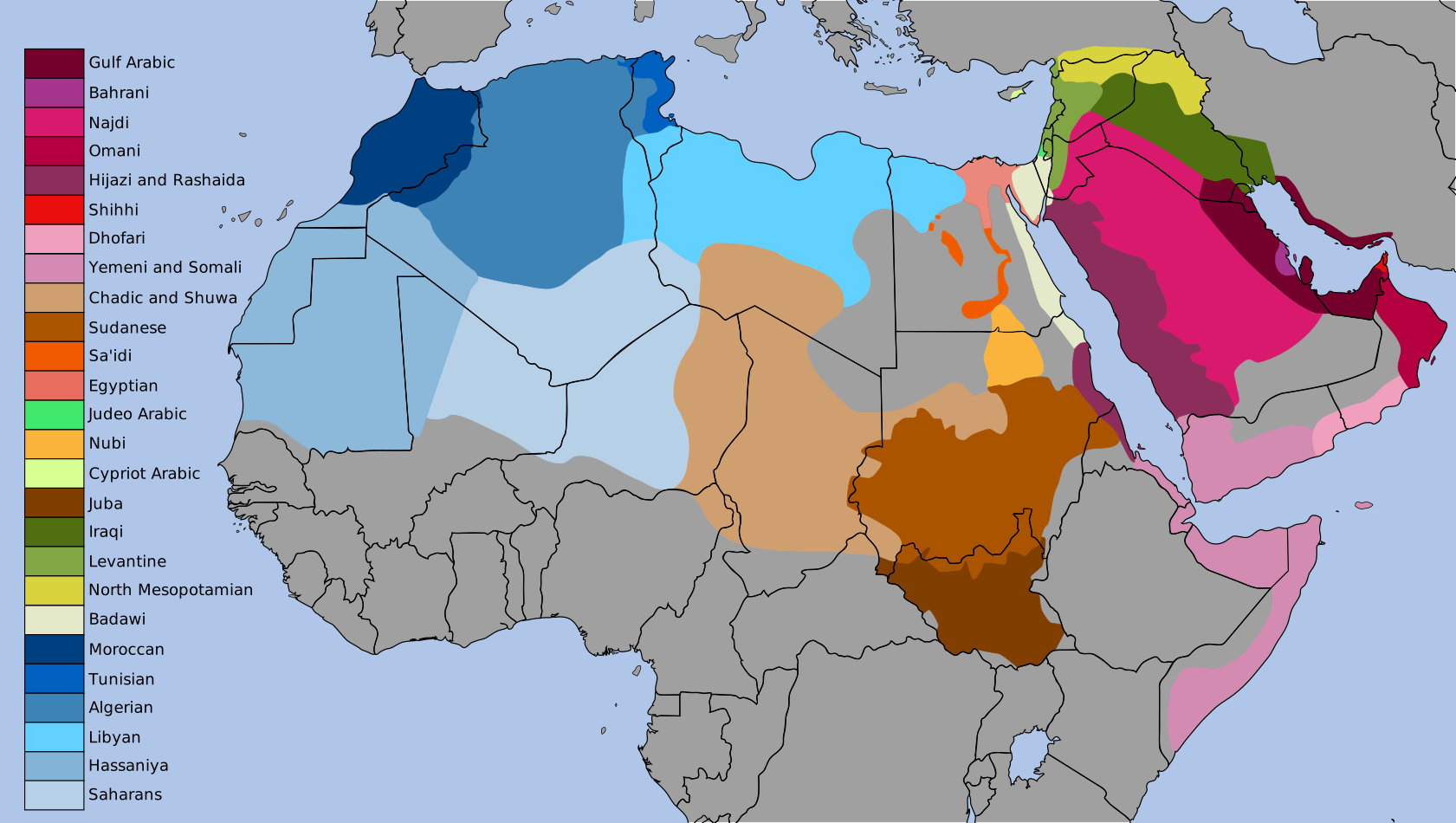
Map of Egypt's Major Accent Regions
Before comparing the different Egyptian accents, it helps to know where the major regions are located. The map below highlights Cairo, Alexandria, the Nile Delta, Port Said, Middle Egypt, and Upper Egypt, the areas referenced throughout this guide. While these aren't exact dialect boundaries, they provide useful geographic context for understanding regional pronunciation differences.
The Sound Features That Make Egyptian Speech Instantly Recognizable
What makes Egyptian speech memorable is not just vocabulary. It is the sound pattern. One of the most famous markers is that the sound corresponding to Classical Arabic ج is pronounced as a hard g in Cairo. Another hallmark is that Classical Arabic ق often becomes a glottal stop in Cairo and much of the Nile Delta, although some words preserve a more explicit qaf pronunciation, and other regions handle it differently. These are among the best-known observations in summaries of Egyptian Arabic phonology and in practical learner explanations of when qaf is still pronounced in Egyptian speech.
Egyptian Arabic also differs from some neighboring dialects in its vowel behavior. Linguistic descriptions note that it preserves the distinction between short i and u more clearly than varieties such as Levantine Arabic, where those vowels often merge toward e in many positions. Egyptian Arabic also uses epenthetic vowels to break up difficult consonant clusters, another detail that helps explain why the rhythm of Egyptian speech feels smoother and more open to many listeners, according to the overview of consonants, vowels, and cluster handling in Egyptian Arabic.
How Egyptian Arabic Often Shapes English Pronunciation
Many articles stop at “Egyptians speak English differently because of Arabic,” but that misses the more interesting phonetic logic underneath. The sound inventory of Egyptian Arabic helps explain recurring English patterns. Because sounds like p, v, and ʒ are marginal or largely confined to loanwords, speakers may substitute more familiar sounds in English, especially in casual or less monitored speech. Linguistic summaries of Egyptian Arabic phonology explicitly note the special status of these sounds.
That is why listeners may hear patterns such as p shifting toward b, v shifting toward f, or English th sounds moving toward more familiar dental or sibilant realizations. The same cluster-breaking habit seen inside Egyptian Arabic can also encourage extra vowels in English words with difficult consonant groupings. These are not random “mistakes.” They are predictable transfers from one sound system into another.
If you want to coach these sound differences more precisely rather than guessing by ear, it helps to combine phonetic transcription with articulation practice. Readers can pair IPA-based pronunciation tools with interactive tongue-position guides for English sounds like TH, V, F, and CH to turn a vague accent observation into a concrete training plan.
Egyptian Arabic vs. MSA and Other Familiar Arabic Varieties
What many learners find surprising is that Egyptian Arabic is not only different from English-accent expectations; it is also different from the Arabic they first encounter in formal study. Compared with Modern Standard Arabic, Egyptian speech sounds more compressed, more colloquial, and more rhythmically fluid. Compared with Levantine Arabic, it often stands out because Egyptian Arabic keeps a clearer distinction between short i and u, while Cairene speech is especially famous for its hard g realization of ج. These comparisons are summarized clearly in the overview of Egyptian Arabic’s phonological contrasts with MSA and Levantine varieties.
Voice Samples and Listening Practice
Reading about an accent is only the first step. Listening to native speakers is the fastest way to recognize pronunciation patterns, rhythm, and regional differences. The resources below will help you hear those features in authentic Egyptian Arabic. The best way to hear Egyptian speech clearly is to combine a dialect explainer, a region-specific sample, and a phrase bank with transliteration and audio. The pronunciation phrases collected by Omniglot’s Egyptian Arabic phrase guide are especially useful for greetings like izayyak, ṣabā il-khayr, and shukrān, while comparative and sample-text videos help learners hear real rhythm and accent placement in context.
Everyday Egyptian Arabic Phrases to Practice
izayyak / izayyik — How are you?
ṣabā il-khayr — Good morning
shukrān — Thank you
inta minayn / inti minayn — Where are you from?
What to train your ear for
Listen for the hard g quality of ج.
Notice where a glottal stop replaces formal qaf.
Pay attention to smoother syllable timing from inserted support vowels.
Compare Cairo-style speech with Alexandrian or broader comparison clips.
How to Study the Accent Without Oversimplifying It
The smartest way to study Egyptian speech is to separate three layers: dialect identity, individual voice, and cross-language accent transfer. First learn what belongs to Egyptian Arabic itself, then notice which traits belong to a specific region or speaker, and only after that examine how those patterns affect English pronunciation. If you want more guided background on accent development and pronunciation learning, Accent Help’s wider blog archive on accents, dialects, and pronunciation technique is a useful companion resource.
Practical training usually works best in this order: listen to authentic Egyptian speech, compare it with formal Arabic, transcribe short segments in IPA, then practice the articulation of specific English sounds that often shift for Egyptian speakers. That is where a combination of phonetic transcription tools and tongue-position visuals for difficult consonants becomes much more useful than generic “accent reduction” advice.
Frequently Asked Questions About the Egyptian Accent
Is Egyptian Arabic the same as Cairene Arabic?
Not exactly. Cairene Arabic is the most influential and best-known variety, but Egyptian Arabic is a broader umbrella covering multiple regional forms. Because Cairo speech dominates media, many learners use the two labels almost interchangeably, but the fuller picture is more regional than that, as shown in the overview of Egyptian Arabic’s internal variation.
Why is Egyptian Arabic so widely understood?
The biggest reasons are cinema, music, television, and long-standing educational influence beyond Egypt. That media reach made Egyptian speech more familiar to many Arabic speakers than other vernaculars, according to the summaries of Cairene Arabic’s regional importance.
What is the most famous sound feature of the Egyptian accent?
For many learners, it is the hard g realization of ج. Close behind that is the Cairene tendency to pronounce ق as a glottal stop in many everyday words, while still preserving qaf in certain common items documented in practical guides like this explanation of qaf exceptions in Egyptian Arabic.
Does the Egyptian accent affect the way Egyptians speak English?
Yes. Like any first language, Egyptian Arabic can shape English pronunciation through sound substitution, cluster smoothing, and transfer of familiar speech rhythms. That is why patterns like p/b, v/f, and adapted th sounds are commonly discussed when analyzing Egyptian-accented English.
What is the best way to practice hearing Egyptian Arabic?
Use a mix of short sample videos, cross-dialect comparison clips, and phrase-based audio. Then reinforce the listening with pronunciation analysis using IPA study tools and articulation guides for tongue placement so that the accent becomes something you can hear, describe, and reproduce more accurately.