Tongue Position for UH
Master the mid-central vowel /ʌ/ sound
Tongue Position Illustration
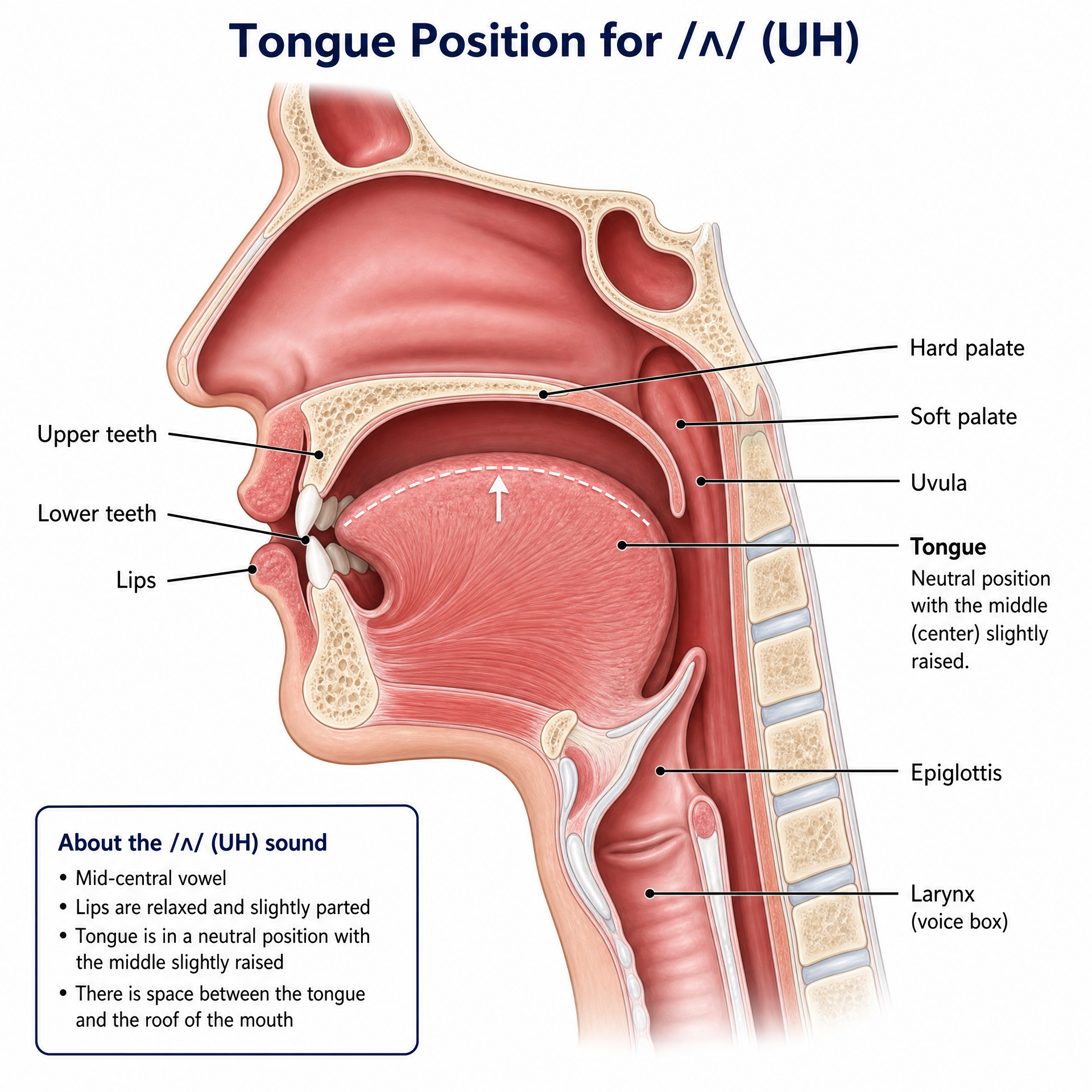
How to Produce the /uh/ Sound
The /uh/ sound is produced by placing your tongue in a neutral position, with the middle slightly raised. Your jaw is dropped slightly, and your lips are relaxed and slightly parted. This is a short vowel sound and is very common in English, appearing in many unstressed syllables.
Side View
The tongue is in a neutral, relaxed position, with the middle slightly raised. The jaw is slightly dropped.
Front View
Lips are relaxed and slightly parted. The tongue is not visible.
💡 Tip: This is a very relaxed sound. Don't try to shape your mouth too much.
Practice Words for /uh/
Listen and repeat these words to practice the /uh/ sound:
Cup
Sun
Luck
Mud
Run
Nut
Minimal Pairs: /uh/ vs /ah/
The /uh/ and /ah/ sounds are often confused. Practice these pairs to hear and produce the difference:
With /uh/
Cup
With /ah/
Cap
With /uh/
Luck
With /ah/
Lock
With /uh/
Mud
With /ah/
Mod
No audioWith /uh/
Run
With /ah/
Ron
No audioWith /uh/
Nut
With /ah/
Not
No audioWith /uh/
Sun
With /ah/
Son
No audioCommon Mistakes with /uh/
-
❌ Mistake: Raising the tongue too high
✓ Fix: Keep your tongue in a relaxed, neutral position. It's a mid-central vowel. -
❌ Mistake: Rounding the lips too much
✓ Fix: Your lips should be relaxed and slightly parted, not rounded. -
❌ Mistake: Confusing /uh/ with /oo/ (as in "moon") or /oh/ (as in "go")
✓ Fix: For /uh/, the tongue is lower and more central than for /oo/ or /oh/.
Practice Tips for /uh/
- 💡 Tip 1: Practice saying words like "uh-oh" to get the feel of the sound.
- 💡 Tip 2: Use a mirror to ensure your lips are relaxed and slightly parted.
- 💡 Tip 3: Practice minimal pairs with /ah/ to clearly distinguish the two sounds.
- 💡 Tip 4: Record yourself and compare with native speaker audio.