How Many Accents Are in the US? Guide to American Regional Speech
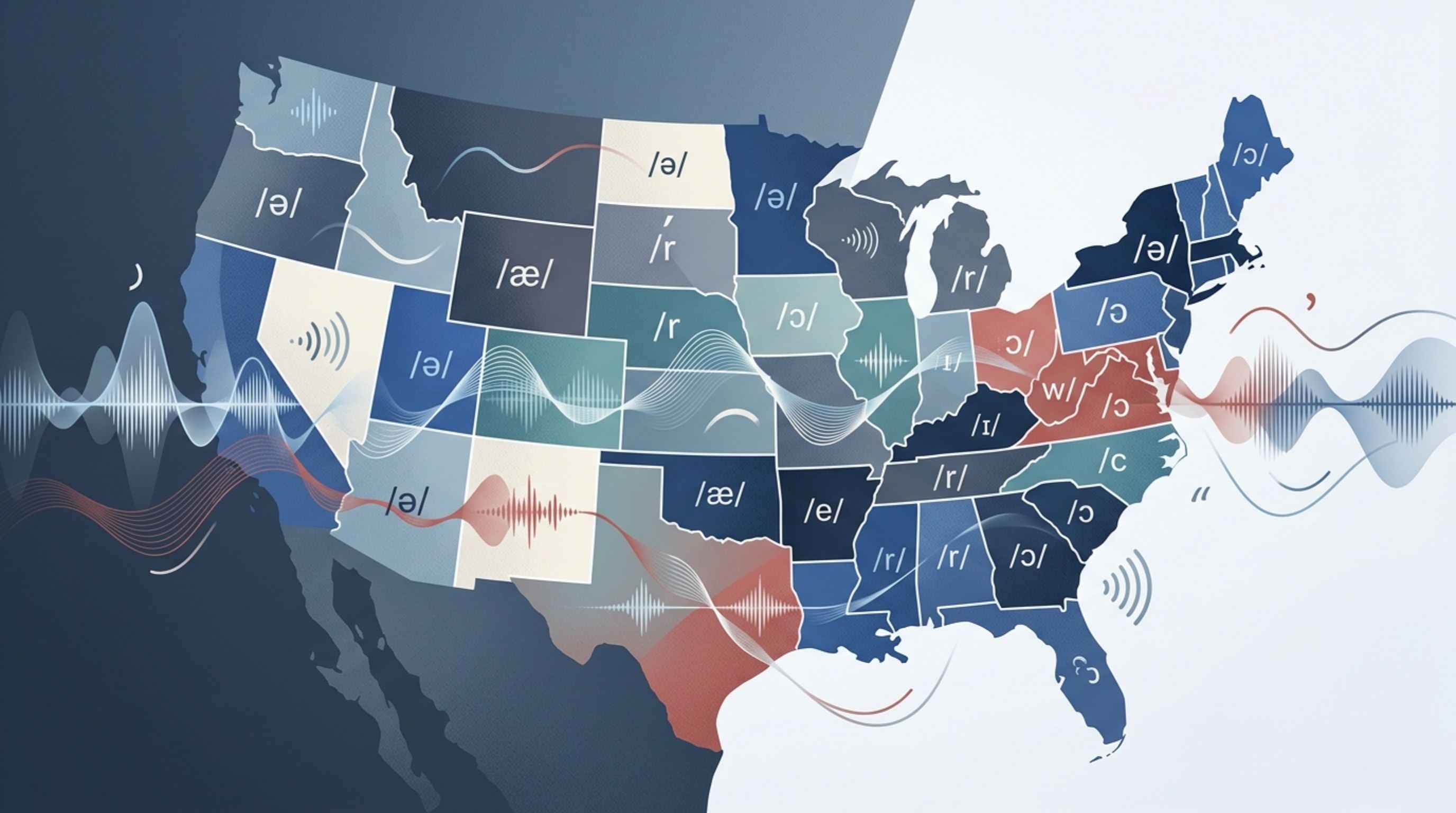
If you have ever asked how many accents are in the US, the honest answer is that there is no single number that every linguist would agree on. That is not because the topic is vague or unimportant. It is because American speech exists on a spectrum, with large regional patterns, city-level varieties, ethnic varieties, social variations, and transitional zones that blend into one another instead of stopping at neat borders.
For practical purposes, many experts begin with a small set of broad dialect regions and then break those into more specific accents. The Telsur national map from the University of Pennsylvania highlights four major phonological regions in American English: the North, the South, the West, and the Midland. Other mapping projects divide the country more finely, sometimes identifying eight major dialect areas across North America before zooming in further to city-specific speech such as New York City, Philadelphia, or New Orleans.
So, How Many Accents Are There in America?
If you need a short answer for a general audience, the safest response is this: the US has dozens of recognizable accents, but linguists often group them into a handful of major regional systems first. That means the answer can be four, eight, thirty, or more depending on whether you are talking about broad regions, local accents, or highly specific community speech patterns.
Practical takeaway: there is no single official count. A broad linguistic overview may start with four major regions, while a more detailed guide may include many more accents shaped by geography, migration, class, ethnicity, and local identity.
Why There Is No Fixed Number
Accents do not behave like state lines. They spread through families, neighborhoods, schools, migration, media, and local identity. That is why one county may sound different from the next, while a major city may sound different again from the surrounding suburbs. Even within one region, younger speakers may shift away from older local features, creating change over time rather than a frozen map.
Another reason counting is difficult is that linguists do not only track vocabulary. They also listen for mergers, chain shifts, vowel placement, rhoticity, and other sound patterns. Two places may use similar words but still sound noticeably different. That is why a speaker might hear a difference between a broad Southern American accent and a more localized Texan speech pattern, even though both belong to the wider Southern speech world represented in the Accent Help accent directory.
The Broadest Way to Divide US Accents
At the broadest level, many teaching and research models begin with four major regions: Northern, Southern, Midland, and Western American speech. This framework is useful because it gives learners a manageable way to understand the country before moving into smaller accent families. It also helps explain why two speakers may both be “American” but still sound quite far apart in rhythm, vowel quality, and melody.
Northern Accents
Northern speech includes multiple systems rather than one single sound. In casual conversation, people often think of the North as a contrast to the South, but in practice there are important internal differences. A speaker in the Inland North may not sound like a speaker from New York City, and neither will sound exactly like someone from Boston or Philadelphia. If you want to compare mainstream American pronunciation with regionally marked city speech, it can be useful to move between the General American accent generator and a more region-specific option such as the New York accent generator or the Philadelphia accent generator.
Southern Accents
Southern American English is one of the most recognized speech families in the country, but it is not one accent either. The South includes Appalachian patterns, coastal patterns, urban Southern speech, and state-level variations such as Texas. That is why a learner comparing the broader Southern accent tool with the more localized Texan accent guide will notice overlap without hearing an exact match.
Midland Accents
The Midland is often described as especially diverse because it sits between stronger regional systems and absorbs a wide range of local influences. That makes it one of the hardest areas to summarize neatly. In public discussion, people sometimes assume Midland speech sounds “neutral,” but linguistically it still contains meaningful patterns and local identities. A useful way to hear that middle ground is to compare the Midwestern accent generator with the General American pronunciation model and then listen for what remains local rather than fully standardized.
Western Accents
Western American English is often perceived as less regionally marked than older East Coast or Southern varieties, yet researchers still identify shared phonological developments across the West. The idea that the West is accent-free is a myth; it is simply that many Western features align more closely with what people think of as mainstream modern American speech.
Why Some Maps Show More Than Four Accents
Broader maps are useful, but they can hide the accents people actually notice in everyday life. That is why more detailed models split the country into additional zones such as Greater New York City, Northern New England, the North Central area, and the South, while also recognizing especially distinctive urban varieties. This is closer to how listeners experience accent in real life: they do not just hear “North” or “South,” they hear New York, Texas, Philadelphia, New Orleans, or a city-adjacent local style.
For site visitors who want a more practical, ear-based comparison, that is exactly where the full Accent Help accent collection becomes useful. Instead of treating the entire country as one sound, it lets readers move between targeted resources such as the New Orleans accent generator, the New York City accent page, the Texan accent tool, and the Philadelphia accent guide to hear how local identity shapes pronunciation.
City Accents vs Regional Accents
One of the biggest mistakes in answering “how many accents are in the US” is mixing up regional categories with city accents. A city accent is often a more concentrated local pattern inside a broader regional system. New York City is the clearest example. It belongs to the northeastern speech landscape, but it is distinct enough that most listeners treat it as its own accent. The same logic applies to places like Philadelphia and New Orleans, where local history and community identity give the speech a sharper profile than a broad regional label alone would suggest.
That is why the best answer is usually layered rather than absolute. You can say the US has a few major regional accent zones, a larger set of well-known regional and urban accents, and then many finer local varieties beneath that. From a content and teaching perspective, that layered explanation is more accurate than picking one number and pretending the debate is settled.
How American Accents Keep Changing
Another reason the number is hard to pin down is that accents are always moving. Some local features weaken, some spread, and some become stronger as communities reclaim regional identity. Research on American dialects repeatedly shows that sound systems do not stand still, especially when mobility, media exposure, and demographic change reshape the way people interact.
For learners and performers, that means an accent resource should be treated as a guide, not as a rigid museum label. If you are training your ear, it helps to compare a broad baseline like General American pronunciation against more regionally marked options in the Accent Help directory of regional accents. That comparison makes it easier to hear what counts as local color and what counts as wider national speech.
A Better Way to Answer the Keyword
If your audience is searching the phrase “how many accents in the US,” a strong, reader-friendly answer is this: America does not have one official number of accents. Linguists often start with four major regions, some maps divide the country into eight or more large dialect zones, and everyday listeners recognize dozens of local accents shaped by region, city, culture, and identity. That answer is accurate, practical, and honest about the limits of any single count.
How to Explore US Accents More Effectively
If you want to go beyond the simple number question, the smartest next step is comparison. Start with a neutral reference point using the General American accent resource, then contrast it with clearly marked varieties like the Southern American guide, the New York City accent tool, the Texan accent page, the Philadelphia accent guide, or the New Orleans accent resource. Hearing those side by side tells you more than any single number ever could.
FAQ
Is there an official number of American accents?
No. There is no single official count because linguists classify accents at different levels of detail, from broad regional systems to city-specific and community-specific varieties.
How many major US accent regions do linguists often start with?
A common broad framework starts with four major phonological regions: North, South, Midland, and West.
Why do some maps show eight or more accents?
More detailed maps split the country into finer dialect areas and highlight local varieties that broad regional models do not show clearly.
What is the best way to learn the differences?
The best approach is comparison. Use a broad standard reference and then contrast it with local or regional accent guides so you can hear the differences in vowels, rhythm, and overall speech pattern.
Final Thoughts
The question is not really whether America has four accents, eight accents, or thirty accents. The better question is how closely you want to look. From a distance, the US can be grouped into a few major speech regions. Up close, it reveals a much richer landscape of local voices. If your goal is understanding, training, or content creation, it is better to think in layers and use practical comparison tools instead of chasing one definitive number.