How Many Arabic Dialects Are There? A Practical Guide for Learners
If you have ever wondered how many Arabic dialects there are, the most honest answer is that it depends on how broadly or narrowly you count them. Arabic is not spoken as one uniform everyday variety across all countries. Instead, it exists as a language with standard written forms and many spoken regional varieties, some of which can differ enough to create real comprehension challenges between speakers from different parts of the Arab world. As Britannica’s overview of the Arabic language explains, the spoken forms differ significantly, and some are even mutually unintelligible.
For a learner, that means the question is not just “how many dialects are there?” but also “which level of difference matters for my goal?” If you are looking for broad categories, Britannica’s breakdown of chief Arabic dialect groups points to major groupings associated with Arabia, Iraq, Syria, Egypt, and North Africa. If you are looking for a more detailed learner-oriented estimate, Middlebury’s guide to choosing an Arabic dialect says that roughly 25 dialects fall under the larger umbrella of Quranic or Classical Arabic, Modern Standard Arabic, and colloquial daily speech.
The Short Answer
A practical short answer is this: Arabic has several major dialect families and roughly two dozen commonly discussed dialect varieties, depending on how specifically you classify them. That is why different articles, teachers, and schools may give different numbers without actually disagreeing on the core reality. Some are counting large regional families, while others are counting more localized spoken varieties.
Quick takeaway: if you mean broad regional families, you can describe Arabic as having a handful of major dialect groups. If you mean everyday spoken varieties across countries and regions, a learner-friendly estimate is roughly 25 dialects, as described in Middlebury’s Arabic dialect overview.
Why the Number Is Hard to Pin Down
Arabic is unusual for many learners because it has a strong standard form used in formal contexts and many spoken varieties used in daily life. Middlebury’s explanation of Arabic learning paths separates the language into three main versions: Quranic or Classical Arabic, Modern Standard Arabic, and colloquial or daily Arabic. That distinction matters because most people asking about Arabic dialects are really asking about the colloquial side of the language, not the formal written standard used in news broadcasts, publications, and official settings.
Once you focus on colloquial speech, the boundaries become less neat. Regional speech changes gradually, city by city and country by country, and the labels people use in conversation do not always match the way linguists group varieties. One teacher may say “Levantine Arabic” as a single category, while another may separate Syrian, Lebanese, Jordanian, and Palestinian speech more carefully. That is why no single number can fully capture the whole Arabic-speaking world.
Major Arabic Dialect Groups
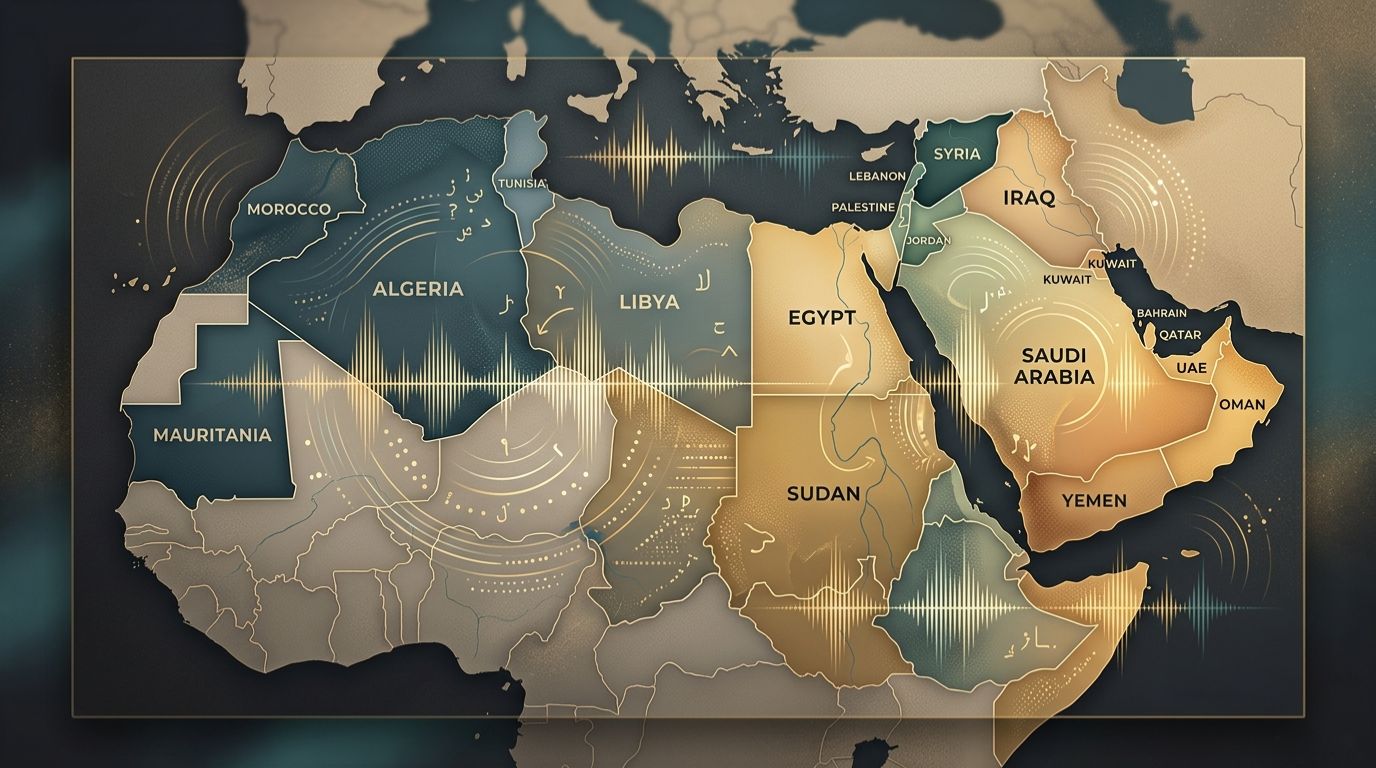
At the broadest level, Britannica’s summary of modern Arabic dialect groups identifies chief dialect zones associated with Arabia, Iraq, Syria, Egypt, and North Africa. These broad categories are helpful because they show that Arabic dialects cluster geographically, even if the internal variation within each cluster can still be significant.
Egyptian Arabic
Egyptian Arabic is often one of the first dialects learners hear about because it has wide cultural reach through film, television, and music. Middlebury’s discussion of Arabic study options notes that Egyptian Arabic is among the most commonly spoken and widely encountered varieties in the Arab world, which makes it especially visible to international learners.
Levantine and Syrian-Region Speech
In many learning contexts, Levantine Arabic covers speech associated with Syria, Lebanon, Jordan, and Palestine. This is a good example of why dialect counting gets complicated: some people treat Levantine as one major branch, while others distinguish several national or local varieties inside it. For teaching purposes, the broader family label is often enough, but for advanced listening work the differences become more important.
Iraqi and Mesopotamian Varieties
Iraqi Arabic sits in its own important zone and is often treated separately from both Levantine and Gulf varieties. It shares some traits with neighboring dialects but still carries a recognizable identity of its own. In an article built around the keyword “how many Arabic dialects are there,” mentioning Iraqi speech helps readers understand that the Arabic map is not just East versus West but a network of distinct historical regions.
Gulf and Arabian Varieties
Speech across the Arabian Peninsula is also diverse. A broad category such as Gulf Arabic or Peninsular Arabic is useful at an introductory level, but actual daily speech varies across countries and local communities. This is another reason learners should think in terms of dialect families first and exact counts second.
North African and Maghrebi Arabic
North African Arabic is often one of the most challenging areas for cross-regional comprehension, especially for learners who start with Egyptian or Levantine materials. Broadly labeled Maghrebi Arabic, this family includes multiple local forms shaped by long contact with other languages and regional histories. Its distinctiveness is one reason many articles emphasize that some Arabic dialects can be difficult for other Arabic speakers to understand without prior exposure.
What About Modern Standard Arabic?
Many beginners confuse Modern Standard Arabic with a spoken dialect, but it is better understood as the formal shared standard used in writing, education, formal speech, and much of the media. Britannica’s description of standard and spoken Arabic explains that Modern Standard Arabic is used in publications and formal broadcasts, while the spoken varieties differ significantly in everyday life. So when someone asks how many Arabic dialects there are, Modern Standard Arabic is part of the picture, but it is not just one more dialect among many.
How Learners Should Think About the Question
If your goal is communication, the better question is often not “How many?” but “Which Arabic dialect should I focus on first?” For example, a student preparing for media, academic, or formal reading needs strong Modern Standard Arabic. A student focused on conversation may choose Egyptian, Levantine, or another high-contact spoken variety depending on region and purpose. Middlebury’s learner guide makes this especially clear by framing dialect choice as a practical decision based on goals rather than prestige.
For readers who want to experiment with accent flavor in English while exploring broader speech identity, the Arabic accent generator from AccentHelp can be a useful related resource. It is designed for accent-inspired writing, dialogue exploration, rehearsal, and quick experimentation rather than formal phonetic training. If you want to compare it with other regional tools, the full AccentHelp accent directory gives a broader view of how the platform organizes accent-based resources across languages and regions.
So, How Many Arabic Dialects Are There Really?
The clearest professional answer is that Arabic has a handful of major dialect families and roughly 25 dialect varieties in many learner-focused classifications, but there is no single universally accepted number. That is not a weakness in the language or in the scholarship. It simply reflects the fact that Arabic is both deeply unified in its literary tradition and richly diverse in its spoken forms.
For SEO and reader clarity, the best answer to the keyword is usually this: Arabic has many dialects, often grouped into major regional families such as Arabian, Iraqi, Syrian or Levantine, Egyptian, and North African, while some educational resources estimate roughly 25 dialects when counted more specifically. That gives readers a truthful answer without pretending the landscape is simpler than it really is.
Final Thoughts
If your audience is searching for a simple number, give them the simple answer first, then explain the nuance. Arabic is not one monolithic spoken form, and it is not a random collection of unrelated languages either. It is a language with a formal standard and a wide range of living spoken varieties. That is exactly why the question remains so interesting for learners, linguists, and anyone exploring pronunciation, identity, and regional speech.
If you want to expand this article further, a natural next step would be to add a follow-up section comparing Egyptian, Levantine, Gulf, and Maghrebi Arabic in more detail while directing curious readers to the AccentHelp accent collection and the Arabic accent exploration tool for related practice and discovery.