Tongue Position for CH
Produce the voiceless affricate /tʃ/ sound
Tongue Position Illustration
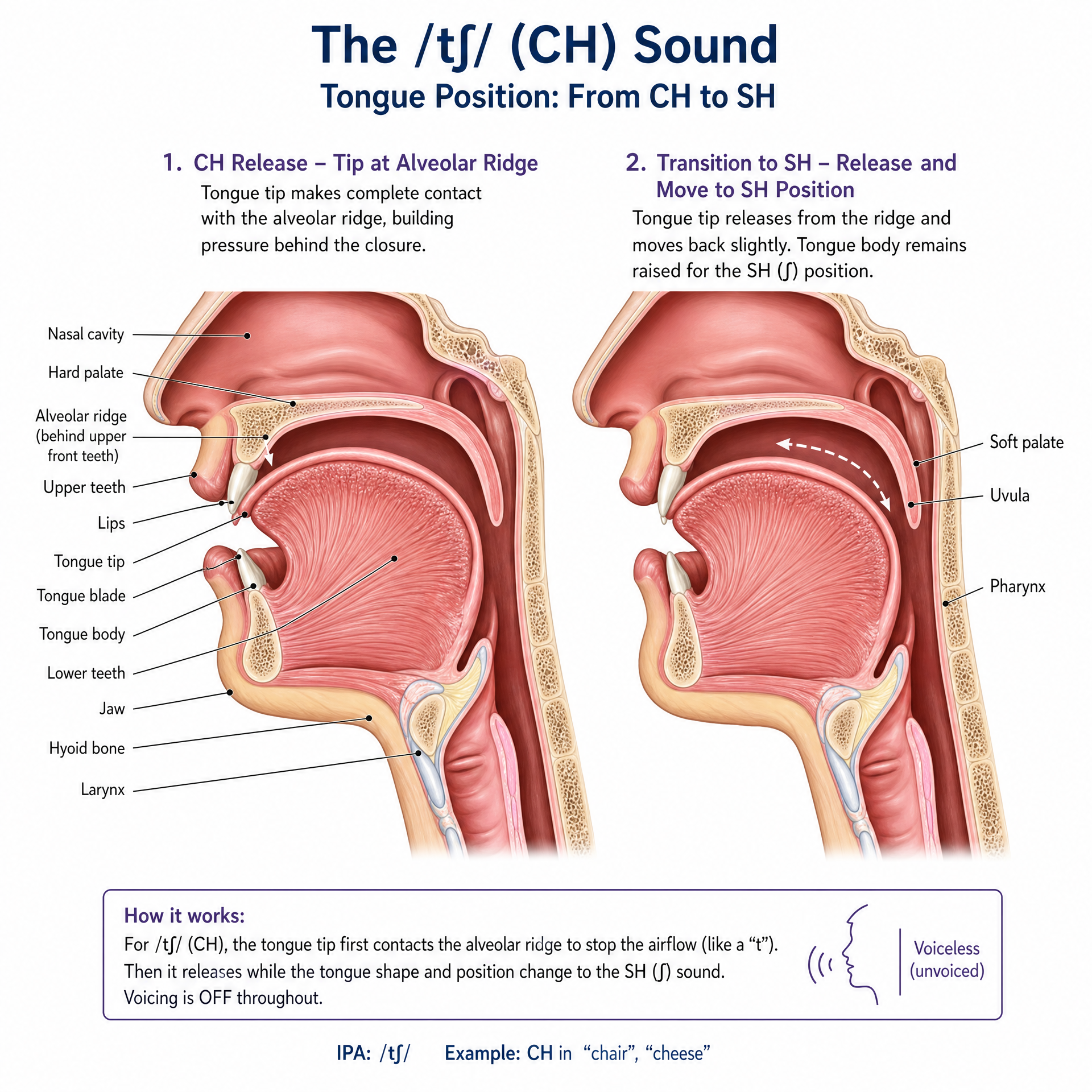
How to Produce the /ch/ Sound
The /ch/ sound is a combination of /t/ and /sh/. Your tongue tip first touches the alveolar ridge to stop the air completely (like /t/), then releases it while the tongue moves into the /sh/ position. Your lips are rounded. This is a voiceless sound.
Side View
The tongue tip starts at the alveolar ridge, then moves back to the postalveolar region with rounded lips.
Front View
Lips are rounded and slightly protruded. The tongue is not visible between the teeth during the release.
💡 Tip: Think of it as a quick, sharp "t" followed immediately by a "sh" sound, blended together.
Practice Words for /ch/
Listen and repeat these words to practice the /ch/ sound:
Chair
Check
Watch
Church
Chin
Cheap
Catch
Teach
Child
Choose
March
Beach
Minimal Pairs: /ch/ vs /sh/
The /ch/ and /sh/ sounds are often confused. Practice these pairs to hear and produce the difference:
With /ch/
Chair
With /sh/
Share
With /ch/
Chip
With /sh/
Ship
With /ch/
Catch
With /sh/
Cash
No audioWith /ch/
Cheap
With /sh/
Sheep
With /ch/
Chin
With /sh/
Shin
No audioWith /ch/
Watch
With /sh/
Wash
Common Mistakes with /ch/
-
❌ Mistake: Not making the initial /t/ stop
✓ Fix: Ensure your tongue firmly touches the alveolar ridge to briefly stop the air before releasing. -
❌ Mistake: Releasing the sound too slowly
✓ Fix: The transition from /t/ to /sh/ should be quick and smooth, almost like one sound. -
❌ Mistake: Confusing /ch/ with /sh/
✓ Fix: Remember the initial stop for /ch/. For /sh/, the air flows continuously.
Practice Tips for /ch/
- 💡 Tip 1: Practice saying "t-sh" very quickly, then blend it into one sound.
- 💡 Tip 2: Use a mirror to observe your lip rounding and tongue movement.
- 💡 Tip 3: Practice minimal pairs with /sh/ to clearly distinguish the two sounds.
- 💡 Tip 4: Record yourself and compare with native speaker audio.