Tongue Position for ZH
Master the voiced postalveolar /ʒ/ sound
Tongue Position Illustration
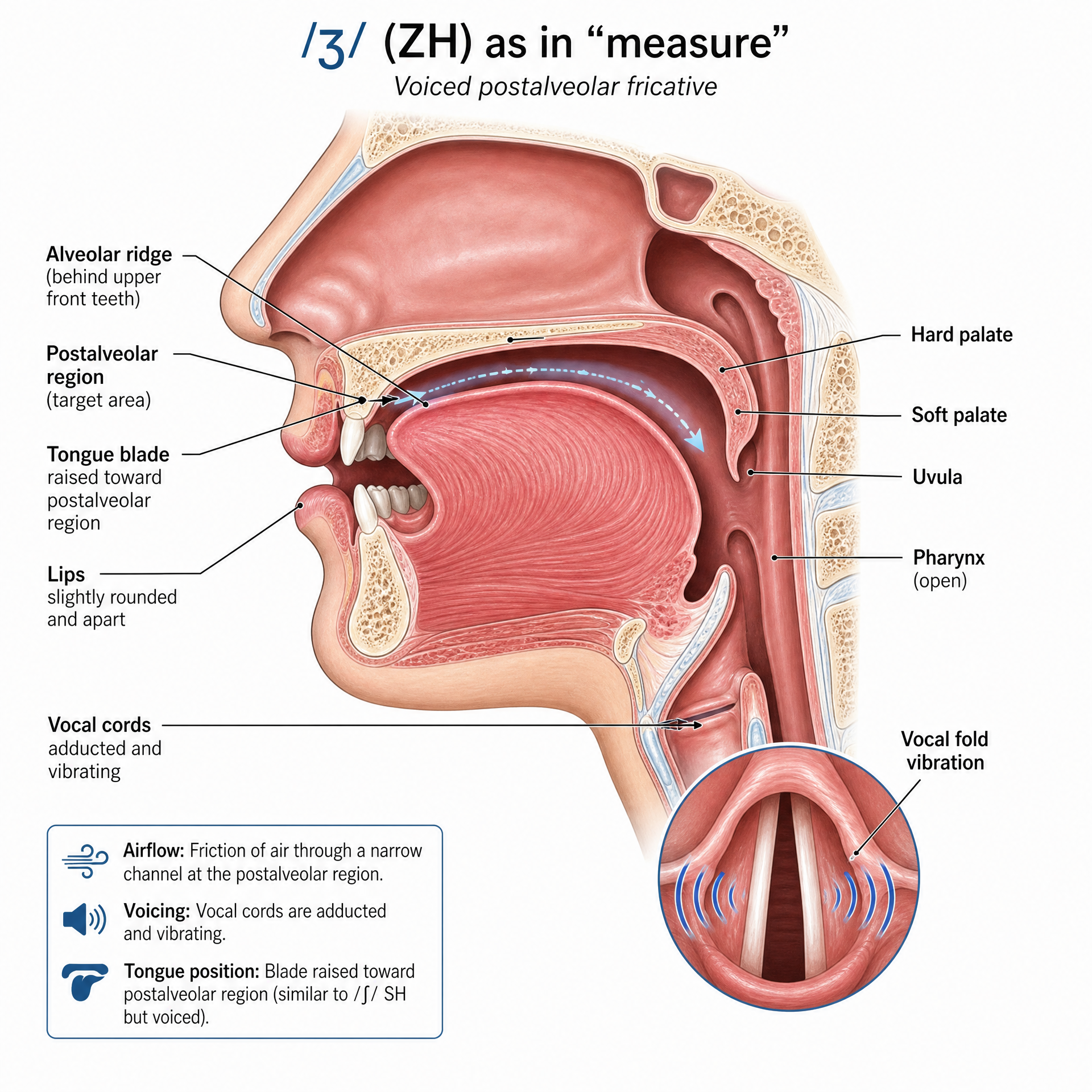
How to Produce the /zh/ Sound
The /zh/ sound is the voiced counterpart of /sh/. The tongue position is identical to /sh/, but your vocal cords vibrate. This sound is less common in English and appears mainly in words borrowed from other languages or in the middle of words.
Side View
The tongue blade is raised towards the postalveolar region. Lips are rounded.
Front View
Lips are rounded and slightly protruded. The tongue is not visible between the teeth.
💡 Tip: This sound is often found in words ending in -sion or -sure. Remember to add voice!
Practice Words for /zh/
Listen and repeat these words to practice the /zh/ sound:
Vision
Measure
Garage
Pleasure
Decision
Treasure
Leisure
Division
Casual
Beige
Minimal Pairs: /zh/ vs /sh/
The /zh/ and /sh/ sounds are often confused. Practice these pairs to hear and produce the difference:
With /zh/
Treasure
With /sh/
Pressure
No audioWith /zh/
Decision
With /sh/
Session
No audioWith /zh/
Division
With /sh/
Mission
No audioWith /zh/
Casual
With /sh/
Cash
No audioWith /zh/
Beige
With /sh/
Page
No audioCommon Mistakes with /zh/
-
❌ Mistake: Forgetting to voice the sound (making it /sh/ instead)
✓ Fix: Remember to vibrate your vocal cords for /zh/. Place your hand on your throat to feel the vibration. -
❌ Mistake: Not rounding the lips enough
✓ Fix: Make sure your lips are visibly rounded and slightly protruded. -
❌ Mistake: Placing the tongue too far back
✓ Fix: The tongue blade should be just behind the alveolar ridge, similar to /sh/.
Practice Tips for /zh/
- 💡 Tip 1: Start by making an /sh/ sound, then add voice while maintaining the same tongue and lip position.
- 💡 Tip 2: Use a mirror to observe your lip rounding and ensure it's consistent with /sh/.
- 💡 Tip 3: Practice minimal pairs with /sh/ to clearly distinguish the voiced and voiceless versions.
- 💡 Tip 4: Record yourself and compare with native speaker audio.