Tongue Position for NG
Produce the velar nasal /ŋ/ sound
Tongue Position Illustration
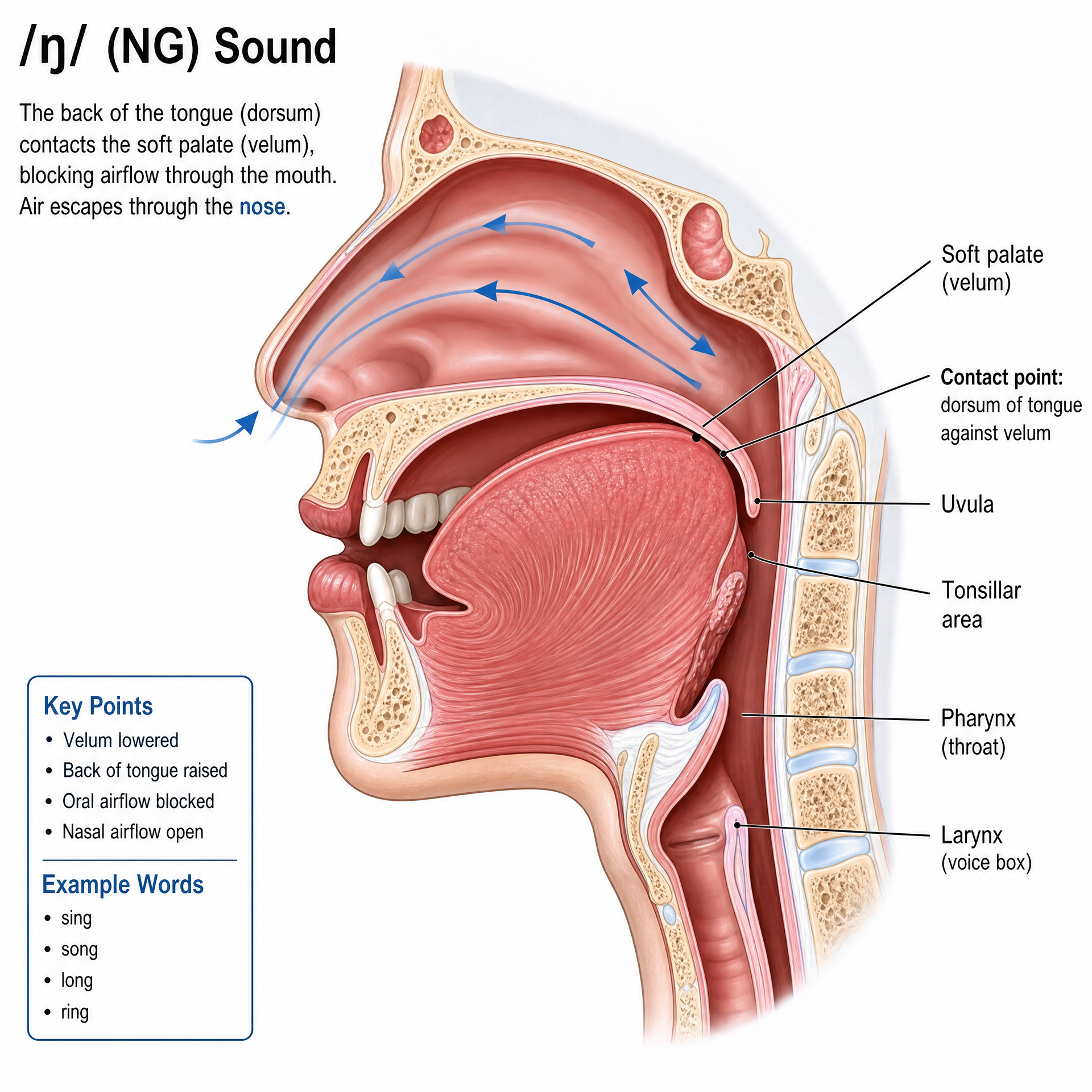
How to Produce the /ng/ Sound
The /ng/ sound is produced by raising the back of your tongue to touch the soft palate (velum) at the back of your mouth. This blocks the air from flowing through the mouth, forcing it to exit through the nose. Your lips are relaxed and slightly open. This is a voiced sound.
Side View
The back of the tongue is raised to touch the soft palate. Air exits through the nose.
Front View
Lips are relaxed and slightly open. The tongue is not visible.
💡 Tip: This is a nasal sound. Feel the vibration in your nose when you make this sound.
Practice Words for /ng/
Listen and repeat these words to practice the /ng/ sound:
Sing
King
Long
Song
Thing
Bring
Strong
Young
Ring
Wing
Spring
Among
Minimal Pairs: /ng/ vs /n/
The /ng/ and /n/ sounds are often confused. Practice these pairs to hear and produce the difference:
With /n/
Sin
With /ng/
Sing
With /n/
Thin
With /ng/
Thing
With /n/
Ran
With /ng/
Rang
With /n/
Ton
No audioWith /ng/
Tongue
No audioWith /n/
Ban
No audioWith /ng/
Bang
No audioWith /n/
Ron
No audioWith /ng/
Wrong
No audioCommon Mistakes with /ng/
-
❌ Mistake: Adding a /g/ sound at the end (e.g., "sing-g" instead of just "sing")
✓ Fix: The /ng/ sound is a single sound. Do not release the tongue from the soft palate with a hard /g/. -
❌ Mistake: Not raising the back of the tongue enough
✓ Fix: Ensure the back of your tongue makes firm contact with the soft palate to block oral airflow. -
❌ Mistake: Allowing air to escape through the mouth instead of the nose
✓ Fix: This is a nasal sound. All air should exit through your nose. Feel the vibration in your nose.
Practice Tips for /ng/
- 💡 Tip 1: Practice saying "mmm-ng" to feel the nasal resonance.
- 💡 Tip 2: Hold your nose while trying to make the sound. If you can't, you're doing it right!
- 💡 Tip 3: Practice minimal pairs with /n/ to clearly distinguish the two sounds.
- 💡 Tip 4: Record yourself and compare with native speaker audio.