Tongue Position for Y
Produce the voiced palatal /j/ sound
Tongue Position Illustration
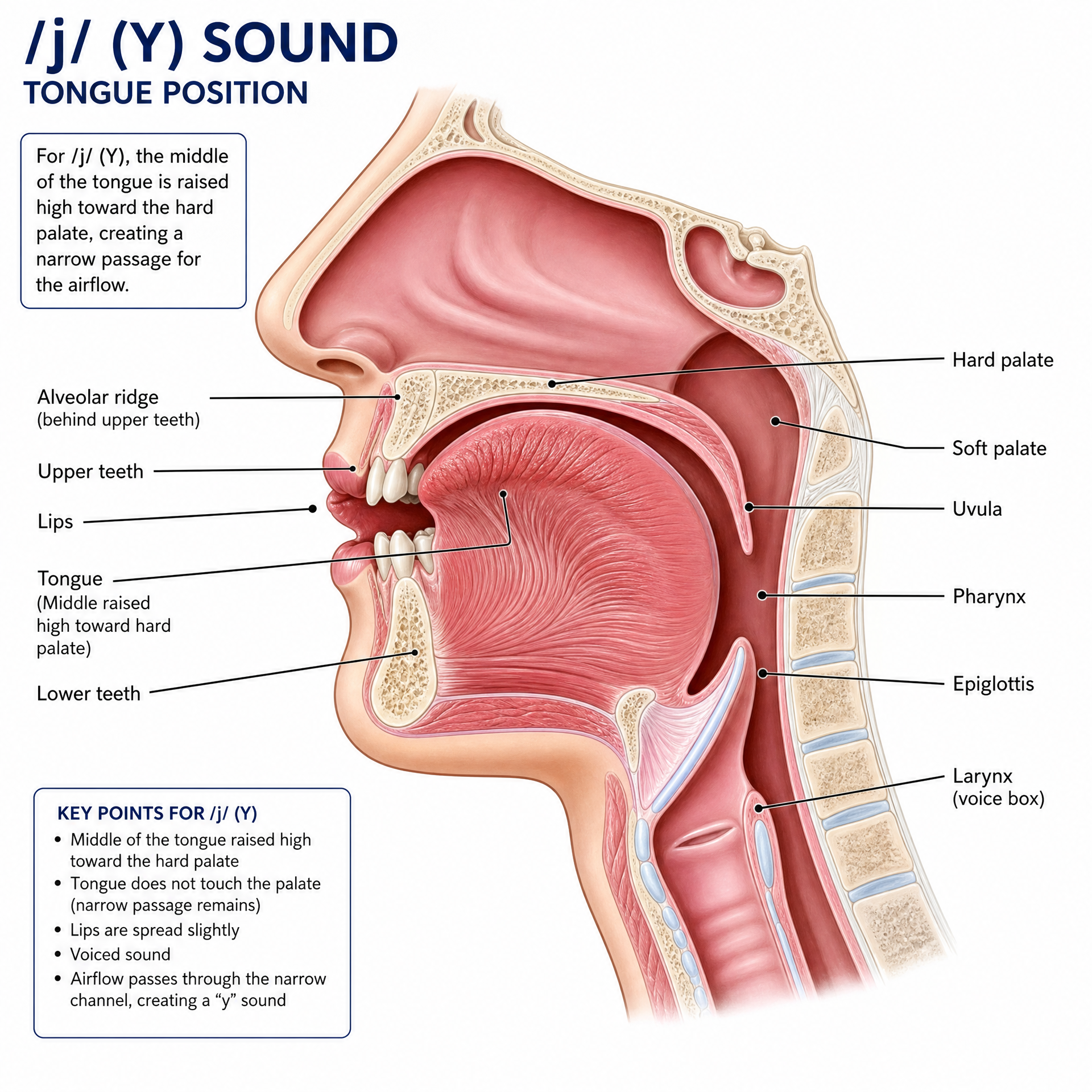
How to Produce the /y/ Sound
The /y/ sound is produced by raising the middle of your tongue high toward the hard palate. The sides of your tongue touch the upper back teeth. Your lips are spread in a slight smile. This is a voiced sound. The /y/ is often considered a semi-vowel because it can function as either a consonant or a vowel.
Side View
The middle of the tongue is raised high towards the hard palate. Lips are spread.
Front View
Lips are spread in a slight smile. The tongue is not visible between the teeth.
💡 Tip: Think of saying the vowel /ee/ (as in "see") and then quickly moving into the next vowel sound.
Practice Words for /y/
Listen and repeat these words to practice the /y/ sound:
Yes
You
Yellow
Year
Young
Yoga
Yogurt
Yield
Yet
Yesterday
Your
Youth
Minimal Pairs: /y/ vs /j/
The /y/ and /j/ sounds are sometimes confused. Practice these pairs to hear and produce the difference:
With /y/
Yes
With /j/
Jess
No audioWith /y/
Year
With /j/
Ear
No audioWith /y/
Yoke
No audioWith /j/
Joke
No audioWith /y/
Yell
No audioWith /j/
Jell
No audioWith /y/
Your
With /j/
Jaw
No audioCommon Mistakes with /y/
-
❌ Mistake: Not raising the tongue high enough
✓ Fix: Ensure the middle of your tongue is close to the hard palate, creating a narrow passage for air. -
❌ Mistake: Confusing /y/ with /j/ (as in "judge")
✓ Fix: The /y/ sound is a glide, not a stop. There should be no complete closure of the airflow. -
❌ Mistake: Making the sound too tense
✓ Fix: Keep your tongue and mouth relaxed. The sound should flow smoothly.
Practice Tips for /y/
- 💡 Tip 1: Start by saying the vowel /ee/ (as in "see"), then quickly transition to another vowel, e.g., "ee-ah" to get "yah".
- 💡 Tip 2: Use a mirror to ensure your lips are spread and not rounded.
- 💡 Tip 3: Practice minimal pairs to clearly distinguish the sound from similar sounds.
- 💡 Tip 4: Record yourself and compare with native speaker audio.