Tongue Position for S
Master the voiceless alveolar /s/ sound
Tongue Position Illustration
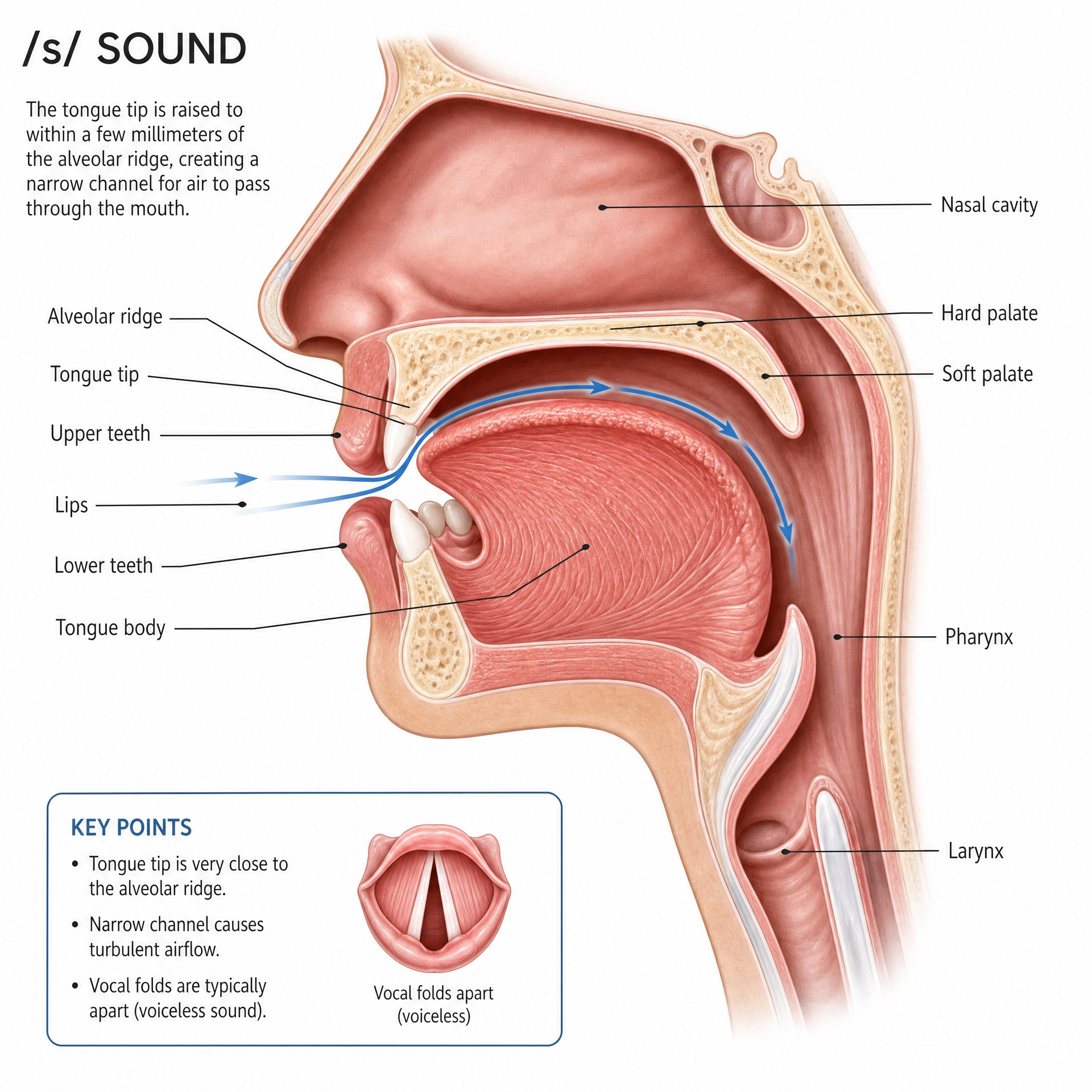
How to Produce the /s/ Sound
The /s/ sound is produced by placing your tongue tip very close to the alveolar ridge, creating a narrow gap for air to hiss through. The sides of your tongue touch the upper teeth. Your teeth are close together, and your lips are slightly spread. This is a voiceless sound.
Side View
The tongue tip is close to the alveolar ridge, creating a narrow channel for air. Lips are slightly spread.
Front View
Teeth are close together, and lips are slightly spread. The tongue is not visible between the teeth.
💡 Tip: The air should hiss out smoothly. If it sounds like a whistle, adjust your tongue position slightly.
Practice Words for /s/
Listen and repeat these words to practice the /s/ sound:
Sun
Sit
See
Stop
Soft
Say
Send
Side
Sing
Six
Soon
Step
Minimal Pairs: /s/ vs /z/
The /s/ and /z/ sounds are often confused. Practice these pairs to hear and produce the difference:
With /s/
Sip
With /z/
Zip
With /s/
Sun
With /z/
Zoo
With /s/
Seal
No audioWith /z/
Zeal
No audioWith /s/
Sink
No audioWith /z/
Zinc
No audioWith /s/
Sap
No audioWith /z/
Zap
No audioWith /s/
Sip
With /z/
Ship
Common Mistakes with /s/
-
❌ Mistake: Placing the tongue too far back (sounding like /sh/)
✓ Fix: Keep the tongue tip close to the alveolar ridge, but not touching it. -
❌ Mistake: Creating too much air pressure (sounding harsh)
✓ Fix: Allow a steady, controlled stream of air to hiss out. -
❌ Mistake: Confusing /s/ with /z/ (adding voice)
✓ Fix: Ensure there is no vocal cord vibration for /s/. Place your hand on your throat to check.
Practice Tips for /s/
- 💡 Tip 1: Practice making a long, steady /s/ sound, like a snake hissing.
- 💡 Tip 2: Use a mirror to ensure your teeth are close together and lips are slightly spread.
- 💡 Tip 3: Practice minimal pairs with /z/ to clearly distinguish the two sounds.
- 💡 Tip 4: Record yourself and compare with native speaker audio.